No…it didn’t start here. Not with the pissed man clutching a crushed beer can in fear on his knees. Not with the other over the wall…somewhere…spilt.
After all, it’s only been how many hours?since I stopped staring at the blank wall of the TV. Only so many hours since I’d finally started listening to that other voice, like I should have been all along. I’d just walked out of the house and into the concrete cold, aiming for the usual trip to the WORLD’s BIGGEST MALL, or so it was once. That should have been the nothing of it.
And then the surprises came.
“M-mac…?”
Nothing much else comes out of him, the beer-piss puddle beneath the man growing as grows the effects of the adrenaline I know I can’t let go of now, no, not now. Not ever. There wasn’t a “going back”. I’d already let go.
No one notices when you slip away, even in the bright orange light of a late autumn afternoon. Instead they sit on their daisy porches unaware of the chill in the air, complaining idly about the Penchant house’s awful lawn.
“It’s rats,” says one of them, sipping a sour lemonade.
“It’s this drought!” coughs another, wiping a grim, wrinkled hand over their parched mouth.
I myself couldn’t say exactly. I’d watched that house a long time; had grown up just across the street, the never-ending parade of “For Sale” signs forever planted in its front yard. One sits there now, dangling and dusty as it has been for the last six years, with nothing but the neighbourhood cats willing to wind their way quickly across the lawn, whiskers high.
Lights off we’d crashed hard onto his grandma’s old sectional, still spinning after yet another long night out during that fateful summer, which was dreary and hazy and covered in smoke. And through that indoor fog of comfortable darkness Aleks had mumbled on, somewhat-lucid, about his dreams: how none were the same, but that they all had a similar feeling. Like knowing for certain you were about to die and praying for the end.
Or, that’s how he’d said it anyway.
“And there’s this sound…” he’d managed to say through the alcohol I could smell on both of us, “…like breaking. Like the sound of rocks breaking. Over and over again. A mountain cracking in half.
I should have listened to him closer, but exhaustion took me. We’d both been too busy at Skip’s, this place where kids like us used to gather just outside of town. It was just that kind of place where equally odd-ended teens could gather and become something of a collective under the stars. Where growls and hoops and howls under the moon were the norm, and encouraged, away from the brick-a-brack of our rural schoolhouse, which taught us nothing, it seemed.
Our crew was all of 17 when we realized that a six-pack left on Skip’s door would get us all hours access to his junk-yard–full of car carcass and bad iron. On nights when it got really cold, Skip didn’t even mind us pulling an old mattress or some sort from his banks of growing mould and trash. With his silence he seemed to encourage us as we dowsed whatever we’d found with a bit of beer and gas, lighting the place up just for something like fun.
Anyway, it was in that half-light, the flickering movement of it, that you could really believe in ghosts and oddities–or at least, the ones that would live in a junk-pile like Skip’s. Piles upon piles of rough and broken invention would stare down at us with eyes that could pierce a soul, if you were drunk enough to think so. And of course, looming down on us always was the Crane.
A monolith, above everything else in town (even the church steeple), the Crane was always the first thing you’d see coming back from a trip to the big city. It stood fast, a marker of that feeling you get when you know you’re travelling back somewhere invisible to the world; when you realize you’re about to become invisible right along with it. Yellow, rusted, weathered, and brutalized by brutal wind, nothing had taken it down, and especially not Man. Even when the huge cement blocks that were screwed in to weight the Crane would turn, the industrial arm moving with it, the whole town would just watch and wait to see if the base would finally give.
We’d all taken more than one turn standing under the cement blocks endlessly weighted to one end–the group of us back then, some nights drunk and hysterical, the wind whipping and us running beneath the creaking arms of the Crane, shouting that it was our name carved in rock between the plates. Some of the braver of our small group, me and Aleks included, climbed all 45 feet of it one night just to hear the wind howl; just to see if there really were any names carved there in stone.
Long after I’d come down, Aleks had stayed. And when he did finally descend, his shirt had been torn, the deep purple mid-section of it, lost against the black sky, waving, invisible, tied to the uppermost rampart of the Crane. I think it was Linds who suggested a couple nights later that we start saluting it at fire-out, just before we would tramp our dirty shoes in the dying ash, sneezing from the rise. Aleks hadn’t done it with us at first, but had lifted his hand to his forehead with us the last few times, dazed, his dark eyes shining red in the low-light of the dying coals.
The end of our last summer together, all of us–me, Aleks, Linds, Milo, and Doug–decided to get together one last time at Skip’s before we all got the hell out of there. I think we all got to his front porch around 11:30, our calendars blaring the event’s signal into the cool, late-autumn evening.
“You bring Skip’s beer?” I ask.
Doug raises his right hand, six cans of the cheapest hanging from his knuckles.
“Looks like Skip’s out,” he mumbles, piling our offering neatly on Skip’s dark stoop before (with almost no effort) catching his foot half-way up the chain-link fence and basically vaulting over, grasping a few links by his hands on the other side. One by one, each of us follow with much more struggle, trying to avoid the clipped barbed wire near the top.
When we arrive, no one else is around. There’s no fire going. From the looks of it, our usual pit hadn’t been lit since we’d last been there ourselves.
“Give me a beer before we start the heavy lifting, huh?” pants Lindsay, wiping her nose on the sleeve of her old man’s army jacket. Aleks, nursing a papercut from the brown paper bag that holds our beer, pops the tab before handing one over.
“Really? Guinness? Who the hell got this thick garbage?” says Lindsay, taking a long drink anyway.
“Doug’s call this time,” Milo laughs, rubbing his hands together. “Whatever, drink it fast, I’m freezing!” he says, fog rising from the heat of his breath.
We drag from the refuse two mattresses this time, piling that on top of an old dresser filled with ancient clothes. We light these slowly, our faces up close to the stench, the beer already making us woozy, watching as the fire takes, slow. The air is quiet between us at first, all of us stepping back to wait for the warmth of it, everyone sipping now and idly watching Lindsay fidget with her portable speaker.
“Can’t it go any louder?” asks Doug after she gets it going. Strangely, the dark night seems to swallow the sound no matter how high Linds pushes the volume.
“Didn’t this happen last time?” someone says. Soon, no one even notices the hidden absence of the barely-there music. Within minutes Milo gets everyone to pitch for a game of Spit. Afterward, Doug and Linds disappear for their usual and come back giggling. I notice Aleks is quiet, but it doesn’t strike me as strange. He seems pretty usual in his favourite trench–the one his Dad had given him the summer before he disappeared. Aleks had just been quiet ever since the guy vanished.
“Look,” says Milo, pointing up with his pocket knife at the first of the night’s fine snowflakes. Mesmerized, all of us fill with a similar sense of now-drunken wonder, a couple dregs of rum left between us from Milo’s flask. Doug curses the early snow as the rest of us trace snowflake patterns through the air with our eyes, watching them disappear into the growing flames, the heat of them now felt. And then…
CRACK
A sound. Like a gunshot. Or a compactor.
The trance is erased, and everyone begins patting themselves down like they’d forgotten what they were supposed to remember. Dougs hands find his phone from his pocket, and it lights his face blue against the reddish blush of the fire’s glow.
“You hear that?” asks Linds of Doug, who shakes his head, putting his phone back in his pocket.
“Wait, where’s Aleks?” I ask. All of us look from one to the other, realizing his spot in the circle is empty, the fire crackling and laughing at us in the background, growing ever higher. A resounding creak from behind us sends shivers down our spines, a million goosebumps covering the napes of our necks. Even the flames seem to recede for a moment from the sound, eating away now at the bedbugs between the burning sheets.
“The Crane,” I whisper, running toward it. With every footfall, more and more of our exhausted conversation from before returns, each word from Aleks’ mouth pounding worry further into my skull as I run, a torrent into the approaching dark:
“They’re like murder,” he’d said, long after we’d stopped talking. “The dreams.”
“Or about it. Like seeing it, and doing it, and being killed all at the same time. It could be anything: watching the trees blow and knowing how many bodies lie below them, and how many bodies below that. I’ll wake up, only to be in another dream, one filled with nothingness: a vast plane filled with hunger and nothing else and you can’t escape. And then the sound, the breaking sound. Every time. Crack! I’m out of it. The waking sound….Like the sound that tells me I’m waking up.”
“What?” I’d asked after a too-long pause.
“The sound it makes. That’s the only time I know I’m really awake.”
I’m the first to arrive.
Aleks is there standing below the cement blocks, their shadow cast in a tight square around him that turns his usually sandy hair pitch black. With every passing second, his coat seems to get bigger on his frame, swaying back and forth, a stark contrast to the stillness in his limbs. The chains and screws holding the cement high above suddenly seem no thicker than sewing thread, and about as strong. There, waving from high atop the crane is a long strip of purple fabric.
“Aleks, what are you doing?” I yell, getting as close as I can without being enveloped by the dark shadows cemented to the ground, contrasted by the glow of a crescent moon. Slowly–he lifts his chin to the sky, his right hand rising to salute.
“Did you hear it?” His voice carries across, though he does not turn. I do not see his face as he stops; as he says it again once more:
“Did you hear it?”
Doug and the rest arrive, blatantly pale, their feet pounding hard against the pavement, so loud that I barely hear Aleks whisper against the growing night:
“Time to wake up.”
There is no drink that will save me from the sound of those cables snapping–how the whole town must have heard the screws coming loose as the Crane was fully relieved of its weight. I remember barely stepping away in time. I remember as thick shards of gravel hit my arms and industrial refuse around that. And Aleks…
I remember Aleks disappearing under it all. Blinking, my vision coated in dust, I saw too the purple strip of his t-shirt fall slowly down, coming to rest atop the pile of dirt and gravel and metal and bone that had erased Aleks from my life forever. Just like his father before him.
But most of all, I remember the sound. Like breaking. Like the sound of rocks breaking. Over and over again.
A mountain cracking in half.
This story was written as a part of WordsofHers’ “Face Your Fears” Short Story Draw, whereby contestants submit their name alongside their worst fears, and one winner receives a spooky short story about themselves encountering that fear to their inbox on Halloween night!
The above story features winner, Aleks, encountering his own worst fear: being crushed alive.
Alone in the middle of a dark stage, our night’s starlet looks out over a quiet crowd of empty seats, listening to the faint echo of future cheers. Every night’s show will begin with her, there, dramatically poised against rows of wooden beams and branches centre-stage, these meant to look like trees and buildings and balconies, the last of which she herself would climb (and does climb now) during the third act of Abscond, Oh Gerry Atrick! — for that is when Wilhelmina catches a deathly case of the Black Plague and falls to her death by tragic suicide. And as she ascends that final step to the balcony, about four or five feet up, she speaks the first lines of Wilhelmina’s monologue as if she’d always known them:
“I’ve grown so cold, moon and stars…I shall go in and grab a blanket!”
Oh, fair world, she can almost taste it! Her soon-to-be-fame on the auditorium air, her, the town’s showstopper, beautiful, regal, her black hair almost plastic in the reflection of the theatre’s distantly red EXIT sign.
A way out, that’s what this is, she thinks, imagining Old Stanley’s face when his play becomes a global sensation all thanks to her. Several sharp teeth peek out between the creases of her divine smile at the thought, while around her the false balcony’s picket railing gives her the sense that she has risen quite above the stage, finally in her rightful place on high.
Of course, she knows—no matter how famous she becomes—that she will always remember that first audition; how she had pleaded with Stanley to let her on-stage — had done ever so much to prove that she is this theatre’s future. And oh, when Stanley had finally said yes! For such an honour he had been rewarded greatly, his hand resting against his chest in awe as he’d listened, stunned, when she’d filled the auditorium with song.
Then, just as she’s caught herself dreaming, comes from Stage Left (as if by cosmic chance) a shadow, something fearsome perhaps, and our Wilhelmina reacts as any such actress (forever in character) might react, shouting: “Gods and spirits, I humbly plead: announce to yon darling…” and then, when the figure below becomes frightened by the sudden sound, its fearsome shadow tripping and stumbling out from behind a threadbare curtain, she screeches, “…who the heck is down there?!”
From below, his bee-hind well-lit by the light of that floating, ethereal EXIT sign, there stands none other than the very man of which our Wilhelmina had just been thinking:
Stanley, stuttering, his bald head twisting this way and that, his shoulders tense and almost touching long-lobed ears as he searches for the source of that voice…
But…she couldn’t be, he thinks.
“It is but an idle wish, to taste of the Blistex of thine frequent neighbour!”
Stanley really jumps then, her very presence confirmed by the badly butchered lines of his masterwork; his own play, thrown back at him in scorn from the mouth of that dastardly witch!
“T-Tammy?” he calls, his voice wobbling.
“Up here!”, and then, lightening her tone a bit for effect, “It’s your Wilhelmina!”
“About that, Tammy…”
“Wilhelmina, won’t you?” says Tammy earnestly, her voice painful like a badly stubbed toe.
“…it’s not that I didn’t consider it, but…”
There’s Stanley, pitiful, the lines of his face visible even in the half-light. No use feeling sorry for yourself, he thinks; you were warned not to let her into the troupe, to never even permit a request for her audition. And yes, he had known his mistake the moment he’d relented. He’d known it even more so when he’d posted the casting list only a second ago — just moments before he’d come to the theatre to hide.
“Yes, I understand Stanley, you wanted to give everyone a chance,” she says, benevolent, the sound sending a cold shudder down his spine.And then to his horror, Stanley must watch as the glassy reflection of her eyes in the red-light grow wide — as she mistakes his doleful silence for assent.
“Oh Stanley, you mean I really did make the list? Oh, you didn’t…”
He can’t help but wonder what he’d done in all his humble years of theatre to deserve this, thinking already about that bottle of whiskey on his shelf at home, and wishing to high heaven he’d gone there instead.
But by then, another thin light has appeared in the dark of the shadowed auditorium, produced by the glow of Tammy’s phone. The blue light highlights her pinched excited face from below, sharpening the harsh corners of it. If he were ever in need of a villain, thinks Stanley, his heart beating loudly in his ears, there she is.
Finally, shaking himself out of it and hoping to salvage whatever remnants could be left, he says, weakly, “yes, that’s exactly it Tammy. I did not-”
But already he knows she’s seen it there, or rather, not there; can already see the list in his mind as she must see it on her phone, absent from top to bottom of her full name, never to be uttered aloud: Tamantha Scudge.
Distraught, and in a state of fugue perhaps, our Tammy steps forward, her hands outstretched, her eyes glazed. What could be made of this tragedy? she thinks, walking straight over the edge of the picketed balcony rail, veritably throwing herself over the edge of it and perhaps forgetting just how far four-or-so feet is to the ground judging by the SMACK, and perhaps too, even with her dress over her head and her bloomers for all to see thinking through the pain that this…this would change everything…
…when…
Well, when…uh, laying there, she…
…uh…she looks up…
She looks up…and uh…or…tries to look up and…can’t because she’s all…caught in the pickets there, and, er, Stanley tries to help, and…
and…
seriously dude?
Stanley tries to-
“No, ok fuck this. CUT!”
The words come from off-stage — off-stage and off-set — barreling from the chest of the heavy-lidded man who sits in an uncomfortable-looking director’s chair, the errant sound and light people all around humming and hawing and looking to the sky. Ignoring him, our narrator (who’s working overtime I might add) continues with the take:
Stanley tries to help, but he…wouldn’t dareth get too close since she’s kind of indecent considering her-
“You can cut it the fuck out too, Nathan.”
…
From a chair that reads “NARRATOR” just off-side, Nathan rises, sweating and pale from hunger, a bent script bound and twisted in his brutal, artists hands, already eyeing the food trays on the table nearby, which he’d been promised hours ago.
“Well, I was just trying my best,” he says, and then, “Mind if I have one of those?” pointing to a pile of pastrami sandwiches, and continuing:
Our ‘director’…
Whoa!
Okay, fine: our director snaps the pen he’s holding clean in half and throws it at the persecuted narrator. A vein bulges dangerously large on his forehead while he mutters about boycotting some writing studio or another and flashes his middle finger at the innocent narrator on-scene.
“Oh, just fuck you Nathan. For real, where did we get this guy? Alright people, we’re doing Take Five in less than ten minutes!”
The director says it loud enough that they’ll have to cut out the sound from whatever they’re filming next door. Then, together, almost holding hands he and ‘Old Stanley’ stalk off through the set door near the real EXIT sign—this one a palsy, faded pink.
…
…
…
From her place on the floor, the production’s leading lady groans in pain, wishing she had just listened to her mother about graduate school-
“You gotta stop doing that, you know Nathan, honestly.”
…she says as her…
“Seriously FUCK. OFF. I’ve got enough of a headache as it is.”
…
…
…
Nathan, his manly moustache covered in crumbs from a particularly tasty pastrami sandwich, nods to the poor actress still there on the floor desperately trying to cover her own ass. He shrugs, saying, off-hand, cool, casual:
“I get paid by the word.”
And, scene.
This story was created in response to NYC Midnight’s Flash Fiction competition. Though it did not place among the almost 3000 great writers in the competition, I thought I would share it here.
For those curious, this competition involves a writing prompt that lists only a place, a genre, and an object, and then you must write a 1000-word flash story in 48 hours. For the story above, my genre was comedy, my object was a list, and the place was a balcony. Here is the feedback I received on this piece as a result of entering the competition (which I have already taken into consideration with the story above, but do comment if I missed something that you think could be improved):
WHAT THE JUDGES LIKED ABOUT YOUR STORY:
{1982} You wrote with vivid descriptions and detail that brought the theater and its goings-on to life. Your prose was dramatic, and it matched the setting and the scene you created. It was a fun commentary on how ridiculous the world of theater/acting can be. I appreciated the meta-commentary you brought, too, in setting a fictional world within a fictional world.
{1777} Drama. Mystery. The feel of another era. It made me think of Shakespeare, thought there are many other writers like him. I liked the description of the wooden beams and branches that somehow transform into trees and balconies – the magic of the theater. Her wish for stardom, her need to prove herself, all offset by the mishap of Stanley stumbling in, unsure. Poor Stanley caught up in his desire to help out. Then her terrible misunderstanding and ghastly fall. I liked the part where the director yells CUT and the narrator continues – best part of the story. But poor Tammy, lying on the floor, bruised and alone. What a day!
{1836} You’re using a bit of an archetype character which is instantly recognizable and relatable to the reader, thus doing a lot of heavy lifting regarding character development which was a strong choice given the limited word count
WHAT THE JUDGES FEEL NEEDS WORK
{1982} Overall, I was confused while reading your story the first time. I had to go back through and read it twice more in order to begin to understand what was going on at the end. You had a lot of moving parts, evolving characters, and a major twist ending that is ambitious for a 1,000 word or less challenge. It could help to simplify your story in order to bring more focus and potency to your finale.
At the end, it was disappointing to see [Tammy] and Old Stanley left with nothing really to do. Because we didn’t get to know who they really were due to them acting, it made for a slightly disappointing ending. It could help to have your audience invest in one character so that there can be that resolution and completeness at the end of your story.
{1777} I had some trouble following the story line. What’s the name of the play? Why is Wilhelmina on a balcony? Why the Elizabethan dialogue? It was difficult to tell if everything not in quotes was the narrator or if some of that was the character’s thoughts/feelings. It would help to differentiate those. Is the play mostly narration with just a little acting? In a play, does the director yell CUT or is that just for movies? I also didn’t understand the abrupt change in language style right after Tammy’s fall. What happens there? Rather than telling us that she’s indecent, show us that she lands with her skirt around her waist.
{1836} Overall this is a nice story, but other than the fish out of water element which we’ve seen before, it’s lacking strong humour. Doing a “jokes” pass would do you well, adding some punch ups to give yourself more of a unique voice.
Allyship, schmallyship. It’s a term we see in every twitter bio these days and we’re not so sure we believe it. Or, at least, that’s how today’s discussion started, with Keighlagh Donovan on one end of a video call at her place, and me on the line at mine.
“Sometimes, I’ll see it on someone’s profile, and I’ll think, but are you though?,” she asks, sipping casually from her water bottle like it’s the hot new tea. We both giggle, as is our way before we dive into seriousness. That’s the beauty of a long and good friendship: you can always tell when the ‘goss’ is going to be good.
“Right?” I begin. “It’s sort of having to ask yourself, are these people just virtue signalling? Are they for real?”
Keighlagh nods, and allows her lovely cat Clover up on her lap. While she pets her absently, I can see the clockworks turning, the years and years of her late-night M.A. research brimming to the surface. (Have I mentioned she’s a PhD fellow at the University of Alberta?)
“But then, that’s when I know it’s me in that moment who is not being a good ally. These self-declared allies are still people with good intent. And they are people who I want to be on my side, so, I never want to gatekeep that. Especially since I think allyship involves not just generosity and compassion, but also some seriously hard self-interrogation.”
I get a bit too close to the screen, squinting my eyes accusingly. “You don’t fool me one bit. Why’d you bring up allyship? Are you working on something right now? You wanna talk about?”
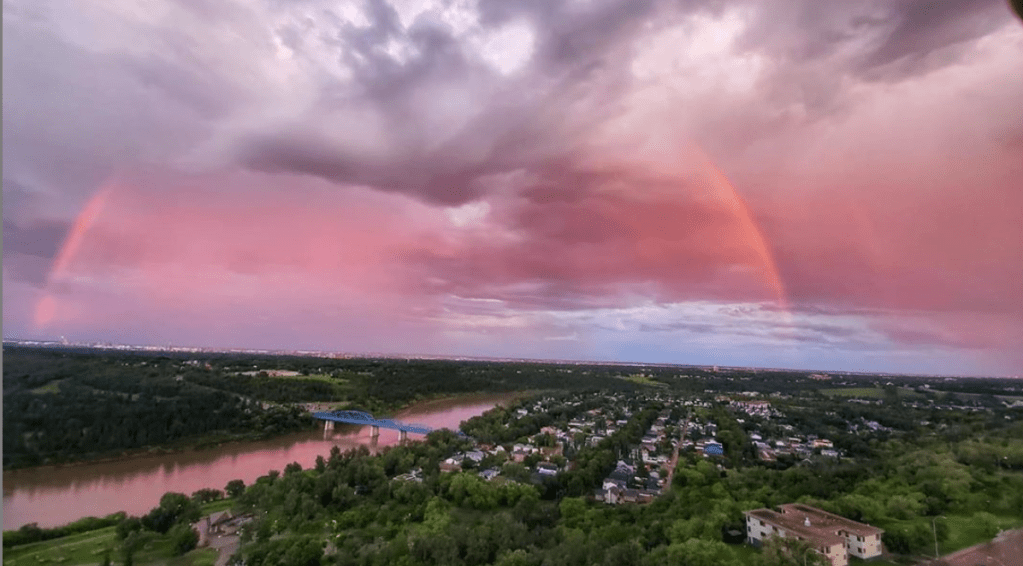
She allows Clover a few more scritches before booping the cat off her lap and readjusting herself closer to the wall behind her, the sun shining there and marking the shadow of a cross-sectioned window pane. I know from experience that from her office she can see out toward my tiny apartment in the distance—that she can see out and across the whole of Edmonton (amiskwaciy-wâskahikan), all the way to where the treeline stops and the prairie begins again.
Photo by Keighlagh Donovan
“Well, I don’t want to bore you.”
“No, seriously. I’ve been doing these interviews with local Edmontonians about different subjects, anywhere from Deathto Swing Dancing…we should do one!”
“Right now?” she asks, her eyes both nervous and excited. I can tell she’s already said yes in her mind, and pull up the voice recorder on my computer screen.
“Let’s do it,” she says.
And that, dear readers, is how two CIS-gender, hetero-normative white girls got to talking about allyship (and its boundaries) late one sunny Friday afternoon in August.
“Go off!” I say, settling in for the long haul with my actual tea (double-spiced chai, if you were wondering) and motioning for her to start.
“Okay…well…”
“In Spite of Discomfort”: A Consideration of Allyship on Treaty Six Territory with Keighlagh Donovan
Photo Credit: Keighlagh Donovan
J: Wait, wait, wait, wait, let me start with some introductions. You’ve been studying at the University of Alberta since 2016, and you’re a PhD fellow with…
K: Yes! With the Department of English and Film Studies. That’s where I was telling you I worked with the Writing Revolution in Place collective, where we were aligning our studies of poetry theory through a course that had us studying with and about writers and peoples from all walks of life and backgrounds from across Edmonton, who aren’t necessarily on campus or already working with the Uni. That’s when I first came to Leanne Simpson, or I should say her full name,Leanne Betasamosake Simpson, who is a Michi Saagiig Nishnaabeg scholar and activist from Toronto.
J: Oh yes! You’ve mentioned her before!
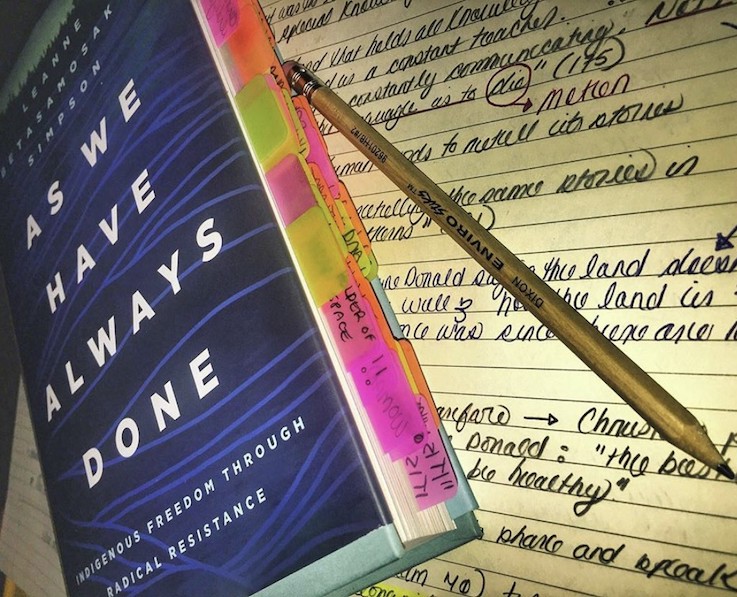
K: Yeah, so she has this great book called As We Have Always Done: Indigenous Freedom Through Radical Resistance, which I began reading on my own time, and even though she made it very clear in her work that she was not speaking to white people or settlers in her text, there was a phrase that just jumped out at me which said something like, and I’m paraphrasing, ‘our white allies will show up in solidarity anyway’.
Photo Credit: Keighlagh Donovan
And for some reason, that just hit me; that was when the word ally really began to take on a real form for me. I began focusing on the word in my work, all while we [WRiP] were focusing on visions of Indigenous knowing through other important writers like Sylvia McAdam and Sharon Venne, which spans and consciously considers seven generations into the future and seven generations into the past.
And honestly, this word just kept coming up in my work, I kept using that quote in essays and articles, and my supervisor at the time [Dr. Christine Stewart] asked me straight-up, ‘what is an ally?’ And in that moment, I realized that, you know, just like those twitter bios, I was using the word but that I didn’t actually know what an ally was, or who was defining it, or even who had the right to define it. So, for the first time I asked myself, ‘If I am just calling myself an ally, does that mean it’s true?’
And then the really big question came to me:
How do I know that I’m a safe space for other people?
J: Right, because we can’t go around with our unearned advantages* saying we’re allies when really it’s those with unearned disadvantages* who might be in a better position to tell us when we’re being good allies, and when we’re not.
K: Yes, exactly, it’s more of a de-centering of ourselves as settlers of this land, and learning a bit of humility when accepting that new knowledge. It was only two and a half years ago now that I really started reading and realizing just how many conceptualizations of allyship had formed my own ideas on how to move through the world and relate to other people, and how I hadn’t really thought about it in terms of allyship or being an ally. Then of course, here I am pursuing this intense literary study of Indigenous land rights and of being on Treaty Six territory, which had me concerned with having good relations as a settler with members of the Indigenous community here-
J: Actually, I’m glad you brought that up (sorry to interrupt). I know that a lot of what we talk about when we get into these chats is about your studies on Indigenous texts, works, and learning, and I can see now that as we’re discussing allyship, just how closely you tie those two concepts together. Did you want to explain a little more about that relationship there?
K: Well, I will say that my awakening to settler colonial history started around the time when the TRC was gaining traction, during a surge of what I’ve heard Marilyn Dumont refer to as a sort of ‘Indigenous Renaissance’ of just so much literary production by Indigenous writers and creators. So it was a combination of that and a very specific graduate course called Treaty Poetics, led by Dr. Christine Stewart and nehiyaw (Cree) language instructor Reuben Quinn, where I suddenly got a fuller picture of treaty history in general, and the treaty agreements that were made on this land. I began to realize that by being here as a settler, that, if I continue to remain here as a settler, I have treaty responsibilities that I must honour, and,so, I really began paying attention to what those are.
So, to answer your question, and to bring it back to allyship, I would say that for any of these communities, non-Indigenous or otherwise, that they are entirely included in that whole mindfulness aspect of allyship I see, in various ways. And at the very root of all of this is this deep sense of responsibility to Treaty, and what I am learning from elders through literature, and how to be-
-Well, that brings me to another point: while looking at allyship in my study, I began to realize in this context that I might not even be so eager now to use the phrase allyship at all, since there are so many alternatives that seem to be better suited to the cause and action involved with what the practice of allyship can mean…
J: Actually, that’s an interesting point. It reminds me of my own experiences using the term intersectionality, which I’ve now learned has a very explicit context and meaning—that there’s a technical aspect to the term which, like grammar, has a proper use. So, I think you and I can both agree that allyship has a bit of a similar element to it, where it has an origin, and an action attached to it, and that we need to pay homage to that when we use the word, since it can be used very emptily—on Twitter, say. (haha).
K: Right! Like, I’ve been testing out the word ‘relative’ or, asking myself, ‘how can I be a good relative?’, instead of just an ally. It’s all about how we frame that relationship. We have to frame in it in a way that is genuine to us.
Image credited to Pekiwewin instagram page: features joyous and generous volunteers and residents exemplifying good intra and inter community relations at Pekiwewin camp. If you have some extra time, cash, or products to donate, learn how you can help here, or volunteer to help directly here.
J: I like that! Very cool. And not that you’re asking, but for me, allyship has always meant sort of: solidarity. Working with.
K: Interesting. Yeah, absolutely.
J: Okay, so next question then, and I’ve been thinking about this a lot, so bear with me if you disagree with the framework of the question, but: we are a couple of CIS-gender, hetero-normative white females. Why do you think it’s important for our demographic to talk ‘amongst ourselves’ about allyship?
K: Like…what do you mean?
J: Sorry, that was a bit leading. I’ve just been thinking, and reading this great book by Ijeoma Oluo, So You Want to Talk About Race, where she talks about how settler populations and non-POC populations (and to me that includes non-queer or abled populations), need to confront each other on these issues. And I’m paraphrasing (probably badly), but she talks about a burden that can sometimes be put on non-white individuals to sort of ‘answer all the racism questions’ for white persons or, as a friend in my anti-racism book club calls it, ‘white-adjacent’ persons. In that work, she talks about how that can be a burden.
So, I guess with my question I meant to ask: why do people like us, who benefit from what Dr. Stephanie Nixon calls in her article-um-The Coin Model of Privilege and Critical Allyship ‘unearned advantage’, need to keep talking about allyship…or being a good relative, without necessarily burdening the populations we want to be allies with? And then also doing that while still learning from those voices?
K: Wow. Okay. Well, now that you say that, and because, you know, I am a literary scholar and student, so I think about everything through that lens, I’m thinking of two quotes. One, I learned from Reuben Quinn, who introduced me to Sharon Venne, an Indigenous Rights Attorney from Muskeg Lake Cree First Nation in Saskatchewan, who has done a lot of work in terms of recording what Elders have had to say surrounding the signing of treaties, and what she says is that we are all treaty people.
“This shit is killing you, too, however much more softly, you stupid motherfucker, you know?”
J: Boom. Wow. I’m speechless.
K: So was I. And it was those key quotes that really hit me off the bat because it’s like: even though, you know, because we are CIS-white hetero women, and even though at the time I was learning all of this I was trying to be conscious of being a good relative—and am still trying to—I was actually living in certain ways that I didn’t think were harmful, which actually were harmful to me and to the people I wanted to be allies with. But then, all of these notions were subverted when I started listening and learning from different communities that weren’t made up of just people like me.
When I read that, it suddenly made me think about how many times in my life I’ve referenced someone’s skin colour, for whatever reason, in a conversation and then realized that I’d never (until recently) been like…’and, he was white!’ It was honestly an awakening. Like an ‘aha!’ moment. It was just so simply stated that it made me reel back very fast through everything I’d ever read, or consumed, and I was just like, oh god: they never had to specify for me that anyone was white. I just assumed.
And that was the break moment. I suddenly started seeing every billboard and commercial, and that I really did expect to see myself represented there. Then I forced myself to see it as if I were in another place, not seeing myself reflected, and how disconcerting that could be. I realized just how ‘not from there’ someone could feel, even though it was in this really privileged way that, you know, others don’t have the benefit of experiencing.
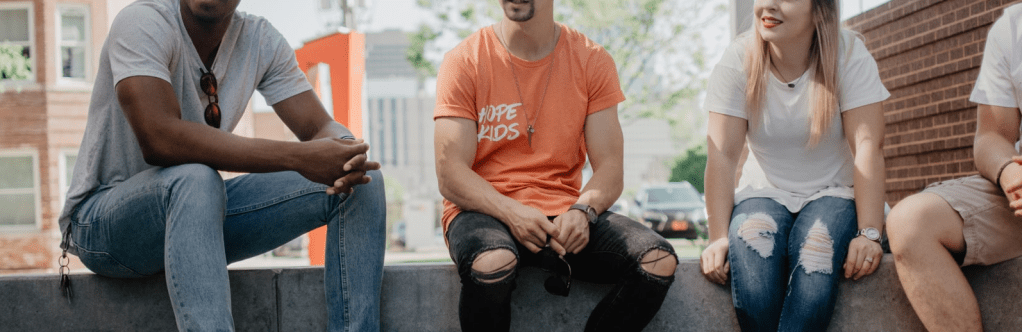
Photo Credit: Christina @ wocintechchat.com
But, of course, that was because I was suddenly reading and recognizing the conversations of people who weren’t me. So, then it became really inherently important for me to honour the humans and relationships I choose to cultivate in this context. So, I’m not sure if that answers the question exactly, but what I mean is that it’s important for everyone to do the work, but especially us.
Or, the important qualifier is that we do this work in spite of discomfort.
Like I said earlier, it has a lot to do with sitting with really uncomfortable confrontations with yourself and those close to you; with a lot of self-interrogation, self-honesty, and unlearnings. And also listening to those who are willing to give you their knowledge, and to respect that gift. We just have to be able to keep moving through being called out, and not give up. It’s just a lifelong pursuit.
[Author’s note: A follow-up from Keighlagh states: “I wanted to share with you directly and personally something I think I missed in your initial questioning. You were asking why it was important for white persons to talk amongst ourselves, and I didn’t think to add another great resource for the topic, which is called Unsettling the Settler Within, by Paulette Regan. There, she refers to the fact that it is not, or it should not, be a non-white person’s responsibility to suffer our decolonizing struggle (along with their own) as we move through it. Just wanted to add that since it’s a really important resource for this question!]
J: So, you would say it’s important for us to make mistakes, to be the buzzkill, as long as we keep working on it?
K: Yeah, the killjoy! And also recognizing that it’s a privilege in itself that we have the choice to show up. It’s great to recognize that.
J:For sure. And actually, I think you did answer my next question there as well, which was how you define allyship, and how that concept comes into practice in your own life in a way that’s not overt. It’s like, when I am talking to people, being conscious of those who helped me get to that point. I’ve found you’re always really good at that—at giving people credit for their words.
K: Thank you! Yeah, I guess…it is important for me to honour that knowledge, and give that sort of…lip service. For lack of a better phrase.
J: Haha, no I get it. What really sticks out for me with your view too, and I think it brings us back to what you said in the beginning about humility, which is that allyship is about not being the kind of person who pretends they’ve known everything since they came out of the womb; of being aware and open to making mistakes, and just doing that work.
K: Yes, I am really trying to work toward that, because sometimes I can fall into that trap where there is this ‘ideal’ ally that I want to be, who aligns with my ideal morals and values, but then, there is this righteous person that comes out more when I try to be perfect, like in the posts I share, or even in writing. I’ll share them in the moment, and I can see that my wording doesn’t rely on the morals and allyship concepts I hold close.
And it’s hard because there is this place of rage. So, for example, if I were to share something that had maybe a shaming undertone—‘if you don’t know this, don’t talk to me’ kind of thing. In the past, and sometimes even now, I’ll see myself making people feel bad for not already knowing. So, being a good ally is catching myself, and remembering that it’s a constant push, trying to be a good ally—for everyone, not just me.
K: So, it’s like I’m trying to find this balance. And I think there is a place for rage and anger, like I said, and especially as a woman and a trauma survivor and sexual assault survivor; there’s a lot of place for rage. And of course, in this capitalistic society where so many people are being hurt, it’s just…
I think part of what I’m understanding about allyship, or what I am trying to refer to as good relations in the context of Treaty, I think it requires me (and those like me) to be more generous. Because like I said, the people I am feeling more angry or ragey toward and having less patience with are actually the people I want (and need) to take along with me. I was in the same pools of these people, but for whatever reason I was able to learn the things that I’ve learned, and I want to be able to afford others the same opportunity.
I think, then, when I think of the word ally or allyship, or how I am trying to be an ally, it’s that I care which is actually so important. And I’m really trying to…learn I am not an authority on certain topics. Or any of the topics I’m addressing through allyship, or relational work. I am trying to be open to that. And compassionate and respectful and responsible. And honouring my relationship with my community.
J: So, I’m getting the sense that you’ve made some pretty big leaps in learning from where you were just two and a half years ago, which is super positive I think, by the way. But now the drama queen in me has to know: What’s the cringiest attempt at allyship you’ve ever witnessed or experienced?
K: Oh, definitely my own! I’ll tell you one. I shared it with you before I’m sure.
K: Oh yeah. Especially since it’s mortifying because of my own interpretations of the event. No one ever told me I did anything wrong or anything. Like I said, I was part of the Treaty Poetics course in my master’s program, which involved us working with Nehiyaw syllabics, and doing a lot of treaty research on the different treaties across Canada, and at the end of the year there was a big treaty poetics performance involving this collaboration, and there was a big drum walking circle, and different people went up and spoke poetry and made different contributions; we were all asked to participate. And I think because I was a part of a graduate course, I felt pressure to perform something to get grades…or to contribute something by way of a performance at all. I think I misunderstood that I had other options.
And so, other classmates of mine did other things like cook certain food or create little cards or someone volunteered to paint the syllabics out on a deer hide. But come presentation day these people are all sitting down in the audience having contributed, and I’m standing up there to present my poetry alongside many others, but I was maybe one of three? white people. And a lot of people showed up from the community, like Cree Elder Bob Cardinal was there, and I found out later that Turtle Island’s sweetheart Billy-Ray Belcourt was in the audience, and so I got up and I read this poem that I had written in this midnight graduate student haze of thinking I had to get this assignment done, and part of that was to…um…yeah…it was to sing a verse of Aretha Franklin’s “Natural Woman”.
J: I mean…
K: Yeah…
And so. I just like sang. And in the context of…it was just. And I got a lot of good feedback and everyone was so nice, some smiles, but I think about it later and I’m like: oh my gosh. You silly white girl. I tried to set it up like… I was sharing an act of vulnerability. But I was mortified later.
J: Honestly that’s not even that bad, but I definitely see what you mean, and how you maybe needed to feel that to like, see it for what it was? Or that seeing that was a mark of your progress toward being a good relative/ ally?
K: Yeah. And what it is, is this…it’s this sense of de-centering myself, how through that I would likely approach the whole thing differently, with an evolved sort of understanding of what being a good relative is.
J:So, what do you think ‘perfect ally Keighlagh’ would have done?
K: Oh gosh, there’s no way to be perfect! That’s what I mean. It’s about knowing that perfection can ruin our attempts to be allies. Or for me, to know that as specifically a CIS-gender, hetero-normative white person.
But you know what?
That was a key moment for me, because I did close off a lot after that. And though I was more scared to share because, at the time, there were a lot of different experiences that discouraged me from speaking out or making mistakes, I began learning over time that that kind of behaviour (silence/non-participation) in itself can be a kind of racism; that it ran counter to my allyship work.
J: I’m not sure I’ve thought about it that way exactly, though it makes me think about how you hear that ‘silence is assent’ or ‘silence is racism’ in other circles or discussions.
K: Right, exactly. And thinking about it…I guess maybe ideal allyship was with me that day, because I do think it involves allowing yourself to make mistakes. It’s important to take risks if we are going to really learn how to be good relatives in the context of treaty, or in any context. And it’s always important to take risks in learning. I think that situation was a kind of risk that was okay. I’ve learned that intent and impact matters (impact more than intent), and I think If we were to weigh the impacts of that action, it was a risk that was worth taking considering what I learned from it.
J: Absolutely! So I guess what I’m getting from you is that allyship is something that comes from a process of learning and falling down, but also of getting back up and trying again, while being conscious that we aren’t hurting the populations we’re trying to be in solidarity with.
I mean. That’s…
Well, that’s a whole hell of a lot more than just putting ‘ally’ on your twitter bio. And I enjoy this perspective of imperfection, because I think we can get pretty lost in trying to be the best, and then being put down (or putting ourselves down) if we fail.
K: Exactly.
J: So, alright, last question then: if we’re trying to be good allies, who would you say are good people to look to for guidance across the board? Or better yet, who are your allyship idols?
K: Well, I know someone not to look up to!
J: Who??
K: J.K. Rowling!
J: Agggghhhh I knoooooow. So hurtful!
K: But seriously, anything by sara ahmed and her blog Feministkilljoys.com is a must-read, specifically her one blog post, “Self-Care as Warfare”.She provided me another one of those aha moments, just when I was really beginning to learn how the dynamics of capitalism and classism affected my own life, and how they had played roles in the context of my own upbringing, and now in broader society. And then this blog just talked about considerations of self-care as survival, and as a means of surviving.
It made me confront this idea of self-care, of what I had thought it meant on a base level. Like, taking baths and doing yoga. So, she really forced me to push that further and consider what kind of self-care I need most. Which for me is recognizing community and my attachment to the land, but for others (and myself though, too), it can be just caring for their/ our own self as resistance. Knowing that it’s not easy for everyone, and that for some it’s (self-care) not even something that’s accessible, since some are not even acknowledged as worthy of self-care under capitalism. So…sara ahmed for sure.
And then, if I can throw out a celeb—I mean, my own idols are people close to me, the women and men I learn from every day online, in community, and on campus—but I also love Johnathan Van Ness!
J: Yessss Hentyyyyy!
K: (Haha)! I just see him doing so many great things. He shares so much information on trans concerns, nonbinary knowledge, politics, diversity…and he does it all with grace and love and patience, and with such self-awareness! He also has that positivity that I really admire, which I mean, he’s totally my ally idol.
J: And why look to idols, you think? Why does that help you, or why might it help others?
K: Well, it’s definitely important to see what’s possible. Because seeing other people getting it right or making mistakes and bouncing back, it makes me feel like, okay, I can do this. I completely respect the people who want to figure this out.
That’s what it is to be an ally. I really think that’s what it boils down to: Caring.
J: Well, Keighlagh. I couldn’t agree more.
Keighlagh Theresa Donovan (she/her) has been a member of Writing Revolution in Place (WRiP) since 2016 and a Ph.D. student and is currently an English Instructor with the University of Alberta English and Film Studies Department. She collaborates on research creation toward adult education and Indigenous LANDBACK initiatives across Treaty 6. In her down time, Keighlagh can be found snuggled up with some fiction, her hubs & two kitty kids Luna Lovegood & Clover.