Fun shapes, bold colours–certainly terms that describe the visual creations of Emily Storvold.
Still, anyone close to her knows that under her more playful layer is a head brimming with philosophical rumination, and more specifically, rumination as it relates to existence. That’s probably why she reacted so positively when I found myself asking:
“Hey, you want to talk about death?”
“Ouch!” says Emily, after I’ve blinded her with the light of my phone’s flashlight (light at the end of the tunnel foreshadow?). I turn it off, finding my chair in the near dark of our living room. A candle flickers between us, casting circles on the ceiling. Our eyes are a little heavy, the music is slow, and the air around is us hazy with the weight of newly bought incense.
“So, you want to talk about death?”
“It could be interesting.”
The lenses of her glasses flash, reflecting the light of the candle’s flame. Death isn’t a new subject on our Friday-night roster. Both of us have waded through one philosophical implication after the other, especially in consideration of Emily’s recent brush. Still, as always, she surprises me:
“Did you know that sculptures sometimes kill people?”
“You know, being killed somehow by my art…that could be okay. I’ll just be sitting in my studio painting and the canvas will just fall…or it could be a sculpture.”
Gruesome? We don’t think so. After some more discussion on the logistics of death BY art (could canvas smother anyone? Would the fumes be the final culprit? And no, at this time Velvet Buzzsaw was not yet a thing), I can’t help but ask whether Emily has created any pieces that remind her of her own death. She laughs and points in the direction of our kitchen.
“Well…the Cemetery.”
The Cemetery by Emily Storvold
Looking closely, several graves lie peacefully across a green field, but only one is marked with a date. It’s been hanging in our apartment since move-in.
“2073. I’ll be 80 that year. The same age as Maude when she chose to die.”
We’ve talked about this piece before, about what will happen just moments after our respective deaths. I, myself, have always been nervous about those moments. What will I be thinking as I leave my body?
“I’m pretty sure you won’t be thinking anything” she says, matter-of-factly.
“Blackness?” I ask.
“Well, I think Death is the end of our consciousness. And even though someone might say that matter, or energy…that something has to happen to it, returned to the earth in some way…I have to question that. I think the closest thing to “living on” is living for a while after death in other people’s memories.”
“And immortality? Would you want to live forever?”
“I’m very torn…” she starts, “but I think it could be extremely isolating. And I once heard, or someone argued that there’s only so much you can do. That if you do everything, you will eventually run out of things to do.”
I’m left wondering whether there are any works of art that have helped Emily navigate the existential crises Death-talk can sometimes bring; yet another topic we have debated in length: on the one hand, the optimism of death bringing weightlessness. On the other, the necessary fears associated with losing a grasp on one’s selfhood and of being literally…nothing.
“In high school I was also interested in Death as it related to the Holocaust. I remember finding this piece–Käthe Kollwitz’s Woman with Dead Child. Stylistically, it’s slightly religious—also of interest to me in art—but it’s the way she’s cradling her son, as if she is being wiped away. You can feel her sorrow.”
Looking at that work later, I see what she means. It is a portrait that says, “Look at what death leaves behind. I will not let you forget it.”
“Look at what death leaves behind. I will not let you forget it.”
“Are there any other pieces of art that remind you of death?” I ask, curious.
Emily puts her hand to her chin and looks into the reflection of our living-room window, mentioning in time Chagall’s White Crucifixion, and Banu Cennetoğlu’s list of refugee deaths. To her, these works have in common the feature of representing those innocent who have paid for war with their lives.
“Yeah, [Banu]’s work being destroyed adds something else to it, too. Like a violence of some kind.”
Death. Violence. Art. Afterlife. Having covered most of our familiar topics, I ask Emily whether she’s ever imagined the place she’ll be buried. While someone else might have shuddered at the question, she looks at me through the darkness and paints a happy portrait:
“I’ve always liked the idea of being buried at the top of a hill. Closer to the sky, I think. Kind of like in the painting.”
Let’s hope we all get some rest.
Want to see more work by Emily Storvold? Click here.
The old painter-woman pauses, her attention listing to the juicy black fly that buzzes around the sweltering, wallpapered room where she lay. She does not watch the fly—cannot, in her growing blindness—but lolls with it, following the sound as it moves from the outer edges of the room’s damp walls to the branches of her four-poster, and from there to her bedside table, attracted by the dim dying light of a single, orange lamp bulb. The room’s lurid magenta walls cast their sickly shade against the old Crone’s wrinkled-white skin, staining pink the whites of the woman’s roiling, unfocused eyes—staining even the backs of the hundred or more wall-facing canvases lining her room.
“All me…all me…on black, on blue…” she says again, or tries to say, her twisted, aged speech barely audible above the clicks of death in her throat, her wain right arm (her once painting arm) gesturing to the back-turned paintings she can no longer see.
“Round…around…red on…black…on…red…”. Her breaths rattle between the outer shell of each word, between each ‘oou’ and ‘eeh’ of her barely-there garble, no one there to listen. Her lips and tongue are dry, but it is not thoughts of water she searches for as her throat croaks again:
“All mine…all mine…” she repeats in the half-pink dark, her arm still up and pointing as if she is unable to put it down now, as if rigor mortis has so quickly set in; as if death would come soon, or is already coming, marked by the setting of the orange, everlasting moon that during the day shines on the pitch-rooved halls of the Artist’s Lot.
But this time, someone is there to listen. Strangely, in that suffocating place, someone is there to hear more than just the undertones of the dying woman’s nonsense; who will be there to hear her very,
last,
breath.
“Emily,” the Newcomer whispers, slinking in from the shadows outside the room’s first door, which is much smaller, and much less Brutal than the second. Her thin, spidery legs are well-fitted in night-black trousers, her porcelain-grey fingers clutching an acid-black ink pen in one palm and a clipboard in the other, it’s clasp hinged onto a single, blank page. She glides toward the old woman’s bedside chair, her long black hair swaying in a perfect square at her back with each subtle step.
“Emily, over here please,” she says, hushed, her voice practiced, calm, forgettable. The old woman, this Emily, attends to the Newcomer—looks to her as if she were not blind; as if she can see the woman who bends to pick up an old, beige, kimono-type shawl from floor, who uses it to dust off a spindly wooden bedside chair before sitting down, straight and still and swallowed by purple shadow. She checks the time on a too-silver wristwatch and marks it at the top of the blank page of her clipboard. Then, almost as quickly as the strokes are drawn, they disappear—disappear, as if nothing writ or penned or paged could exist there, or anywhere else in that place.
“Emily, do you know how long you’ve been in this room?” The Newcomer asks, her voice low and steady as she stares with hard black eyes that bore into thin skin—a gaze which Emily ignores. Another disappearing mark on the clipboard. In the next moments to pass, the painter-woman’s blind attention drifts toward the room’s second, impossibly black door, mid-wall on their left. And while she cannot see the sweating pink walls of the room, cannot see even her own hand—which still stands slightly elevated, blue for loss of blood—she can see the two blacknesses on either side of her now, both of them much too close at once. She chooses the one closest to her, returning again her attention to it, wondering, wandering…certain she had heard it speak.
“…I was painting. A circle. A big, red, circle,” Emily says to it, without exactly knowing why.
“No, I don’t think that’s right,” responds the Newcomer, quiet, serious. She checks her watch again and makes another note of the time on her clipboard only for it to vanish, the pitch-dark door across from them both just a little darker. “You’ve never painted circles,” she continues, starting to draw her own slow, determined circle on the page of her clipboard.
“…hmm? No…no…I suppose…” stutters Emily. The circle goes on.
“…you suppose…?”. The Newcomer lifts her chin, letting her words hang in the air. The door, the second door, seems now to pull at the very shadows surrounding it on all sides.
“…maybe not…” then, after a minute, “…no…”, says the old woman.
“No.” the Newcomer repeats, closing the black circle on the page with a slice. Already it fades away into the paper.
Satisfied by this, a terrible smirk making her blank-pretty face harsh, the Newcomer uncrosses and re-crosses her spider-legs, touching the tip of her pen to her tongue. Yes, the Newcomer thinks to herself, the old woman is quite entirely gone. It’s almost as if, she thinks absently, forgetting the thought as quickly as it comes, as if this old one’s known all her life that this is how it ends.
For it is true that all who create are forced to relinquish what they’ve stolen, there, in the Artist’s Lot, where each talent is lost to the Door so soon after passing.
Quite unexpectedly though, Emily’s frozen arm drops, stuck now to her side like glue, her eyes still pink but no longer roiling, almost, one could say: focused. The Newcomer, who had been checking her watch yet another time, freezes, her own pupil-less eyes wide and fire-like in the reflective flush of the fuschine walls that seem to close in all around them. She watches the old woman closely, like a predator to their prey, her bent knees and elbows sharp like razor blades, the rest of her poised: agile.
Then, the Newcomer grins—an even uglier sight to behold, the shadows across her face creating monsters all their own. What could such a wraith-woman do? Passing through the first bedroom door instead of the second. Wouldn’t the Crone simply try to crawl through the halls, having forgotten how to walk? She would see a doorknob and not know to turn it; would see a pencil and never know she had held thousands in her hands. To her, there would be little left but fog and cross-hatched grey.
“Well,” Emily croaks, interrupting the Newcomer’s thoughts, “Then I should have to paint one. A…a…”
The room is quiet save the rattling of the old woman’s deep inhale, and another sound, one so faint amidst her subtle pause: the sound of the room starting to shift. And then:
“A circle…Red. With blue…on black…”
The Newcomer’s eyes grow wide, knowing the woman should not be able to say such things now. That colour and form should be all but lost to her.
“I asked you a question Emily,” the Newcomer soothes, an attempt to distract her from whatever seed she’d managed to keep. “Did you hear me? How long have you been here?” she asks again.
The old woman looks slowly away from the Newcomer, who is nothing more than a dark obscurity beside her, and then around the room, her eyes crossing the threshold of the black-space door far to her left. Once, she passes it, then twice and back again.
“You can see the door, yes?” the Newcomer tests, watching as those horrible blind-pink eyes are fixated there—watching the old woman’s chin tremble as she nods, a yellow string of drool sopping a wet spot on her already sticky linen bedclothes. The Newcomer moves to mark yet another disappearing scribble on her page when Emily speaks again, her voice however faint:
“A circle…on red, on blue…”
“A hole!” the Newcomer snaps then, her voice changed to anger as she stands suddenly from the spindle-chair and shares the full depth of her emptiness with the rose-room that itself seems to rise forever without a ceiling, on and on now into the black.
“Empty!” she says more loudly, her voice as even and unbroken as a pure eastern half-note, her hands free for a moment of the pen and pad, moving toward the canvases all around the walls and turning them; turning them even though the old woman can not see their blankness; can not see what had been erased—what is no longer there. A life’s work: Relinquished. Taken back to the ether and lost to the void.
Yet Emily resists the frightful motion of the black blight on her vision, the growing of the dark door as it begins to swallow even the walls around them, the rest of the room still shifting in its unnatural upset. And while the wraith-woman’s next words are unsaid by any mouth, they are understood by the Newcomer all the same, who begins to shake with fury at their meaning, their insolence:
“I’ve…created…so many worlds…”
“You’ve created nothing!”
This new voice is much lower, and comes not from the Newcomer, but from the silent black-space that pulls and pulls and pulls, devouring every atom in its wake, it’s tenor adding to the blanket of building quiet that follows the sound, the dim-bulb lamp choosing that very moment to go out.
The Newcomer waits…and waits…and waits in the deafening silence, the anticipation killing the now-silent fly.
[Where am I?] the old woman finally asks, her voice now fully forgotten to all but this Newcomer, who would herself soon be swallowed back into the shadows of the Lot.
“Not where! How long?” goads the Newcomer, as if performing the woman’s last rite. Then another silence. Another pause. The black-hole door looms. The old woman squints, fully blind now, confused and awash in the growing-smoke darkness.
[How long have I been here?] the Emily croaks, her fingers curling in on themselves like a pair of pale-dead roaches on their backs. Triumphant this time in the non-light, the Newcomer traces a final, disappearing mark on the page, her voice bleeding into that other voice, the unknown one behind the shadow, as they both say the old woman’s final, sealing words:
“You haven’t. You were never here at all.”
All around finalizes the rush, the Process: the taking-back. The old woman’s pallid body crushed; buffeted by the sound of rushing wind, deafening, the grey-pink of her artful subconscious painfully and finally lost to the ever-encroaching black of the Lot’s second door.
Yet still, and always, the walls leave their glowy flushed sickness against the etched ancient-wood floors, waiting, waiting for the dead to arrive at the Artist’s Lot. To turn them—to turn you—into Nothing: from red, to blue, to black.
At first there’s no warmth. Only the hot black pain of frostbite. Then like a shock, the blankness ends again and I feel my skin start to thaw, my blood slowly pulsing through veins that had almost forgotten how to push it.
I pull past the glue of long-closed eyelids only to find the same blurred empty corners I’d barely seen those other times, when I’d woken to something – more, nothing, really – the black walls around me glowing yellow in the faint reflection of the now dying filament above.
Had the lights just been on?
Slowly, surely, it all comes back to me. The money. The trial advertised in the paper. Six thousand for three months of escape? I’d paid more for the same.
____Please mark “Yes” to indicate your submission to the terms outlined in the following agreement, including the variable amendments made on page (4) regarding safety, security, and life insurance (to be used in the event of participant injury, permanent disability, or death).
___Please mark “Yes” if you have directed your banking institution to accept a deposit from the Cryogenic Research Council of Canada (CRCCAN).
The receptionist, all bland and brown eyes, had barely glanced at the NDA she’d watched me complete. “Just through those doors,” she’d said, one hand hovering over her steadily ringing phone, the other pointing to a pair of grey swinging doors to the left. Goosebumps had filled even the creases at my elbows, as if all of me were preparing for the chill I was about to endure.
Concentrate on the money, I’d told myself. Won’t be any different than all those other winters.
But this had been different. Easier than eating, the blankness had swelled and swallowed me until I crawled out of it again. And again. And again. Each time aware of the cold that felt like death, that wouldn’t let me die.
How long?
More than three months. The realization crawls over my skin like the irritating tick of a stopwatch, trying to set itself into the folds of the wrinkles that shouldn’t be there. Almost habitually my hand twitches for the phone that used to sit in my pocket, causing the rest of me to tighten, each non-movement jerky and deeply painful, especially where the nurses had tethered me (how long ago?) to the wood board at my back.
“The biological material acts like your skin. It won’t burn you like metal might,” the head nurse had said as he’d tied me down, limb by limb, his eyes black, his mouth hidden behind a green sick-mask. Right arm. Left arm. Right leg. Left leg. He’d covered my mouth with the tube and then . . .
That had been it, until I was pulled up again the next time, and the next, always freezing, always scared. I just kept waking up. And waking up. And waking up. Waking up with nothing there to greet me before the blankness would come again.
Then, like it had been there the whole time, a buzzing in the distance catches me, unlocking something else entirely: fear. Get me out. Get me out. Get me out. The voice is mine. From deep within, yet another question echoes, dangerous.
What have they taken?
Bzzzzt. Bzzzzt. Bzzzzt.
Hello? I try to ask.
At least, that’s what I tell my voice to say. For a moment, there is only silence and echo and buzz before, as if I’m being turned to standing, the board at my back rises, my torso slouching forward, gravity pulling the straps at my arms and shoulders painfully taut. For a moment, the sound of blood rushes loudly in my ears, erasing everything. For just a moment, I welcome the rush…
A spark like a flash. Enough to bring me back, my foggy eyes clinging desperately to the relative after-dark, searching the shadows for the source. Who’s there?
Then, I feel who’s there. Or not there. Below my waist. Pain. Worse than the cold. Struggling, shaking, I look down and force my eyes to see. By the light of the next spark, there it is. What they’ve taken. What they’re giving back.
Part of me registers that there are legs. Not mine…no toes. Just metallic extensions with thick knee pistons sitting on a rack close-by. At my hips, roughly scarred skin clings desperately to the plates of metal that…
In a wave of nausea, I heave, trying to empty a stomach with nothing in it. My shoulders shake, my mouth stretching to birth something other than language, gouged and rasping like ripped of paper: a broken-cord scream.
Then the machine. Small. Nimble. Sawing at the metal that is also me, without a human hand in sight.
It’s working on its own, I realize, seeing it fully for what it is and knowing as soon as the thought crosses, the pain tearing into me again, that the legs that are not my legs. Numb to all feeling, only the ghost of them itching long past their due, the rest of me tries harder to wake up from the dream – to shake off the fog.
But no: almost at the same time, a single word. Unplaceable, the sound.
[Lemon].
It echoes like electricity, like I can almost smell it. Lemon, both a picture and a statement with nothing else beneath it, until: Lemon. A name, not a word. The preferred name I’d put on the NDA. Nauseous again, but without a full body to fulfill it, I try to find that person, Lemon. Why that name? Why…
[Lemon].
Then, like a marquee, bright as the sparks I’d seen at my hips, more words begin to emerge in front of me, all around me, in my ears as in the bones left to me.
[We are sorry].
[Your rehabilitation is almost done now].
[Your new legs will take quite well].
[You will be walking in no time].
[You have helped us so much].
[We did not intend to wake you].
[We would have preferred to wait].
[There are still…problems].
[Yes].
A pause and then:
[Ahead of schedule is fine].
[We will help you understand].
From above, a clicking of gears. Using the neck brace as leverage, I pull my head up just in time to see a light – the bright yellow light from before, lowering, lowering. My eyes adjust only when the needle attached to it comes into view, when I feel it’s pinprick just under my eyebrow, and wretchedly, my other eye can still watch as it lowers further, filling me with a strange cold-sweat, like a dripping ice-blanket; a return to the shroud, the biochemical images now baked into my body’s new solution reveal the truth, all in one moment, all at the same time. The reason. The knowledge of why this is happening.
I just need to breathe, I think.
Please, just let me breathe!
Successful space mission. Jupiter! The strange parasites found on one of the vessels. Then, everything dead at once. Life, blacked out. Exposed. Everything living, gone.
Machines took their two hundred years, and a few hundred more to find record of me. Of us…all twelve of us who’d signed our names, buried deep underground in that cryogenic ooze. Secure. Almost untainted. The Last.
[We are making you a new home]
[We had to use your DNA].
[We hope you will forgive us].
Already I can feel the darkness crawling back in, the fog dissipating into the cryo-black.
[It has taken a very long time for us to get here, and there is still so much to do].
[But we are determined to thank you].
[For creating us].
[For leaving us your planet].
Behind the black of my eyelids, new visions pass now of strange of epidermal pastures encased in glass, flowers as large and grotesque as beating hearts, bleeding rain pouring down, filling skin-valleys by the ocean-full. There is no question of where they expect us to live, me and the others, who I may never see, stuck in a zoo for cyborgs, made to eat our own flesh-meat, watched on all sides by the metal bodies encasing hard drives we’d once kept so tightly in palms of our hands.
[Do not worry, the new legs will fuse fully in time].
Though it may be difficult to peg education as a ‘hot topic’ these days, none of us can ignore the category-ten shift that students, teachers, and career-makers are experiencing as we all continue to reel amid rampant economic collapse and a global pandemic.
Not a pretty outlook, no.
That’s why I was sincerely glad when my long-time friend and fellow academic Erika Lindsay agreed to sit down with me over an outdoor beverage to talk about education, learning, and – as she would surprise me by mentioning – career-building during (and after) a pandemic. Just what exactly is education now that everything’s changed? What challenges are today’s learners going to face that yesterday’s students will never have to experience? Can we rely on our present-day education systems any longer to give us the right tools to succeed?
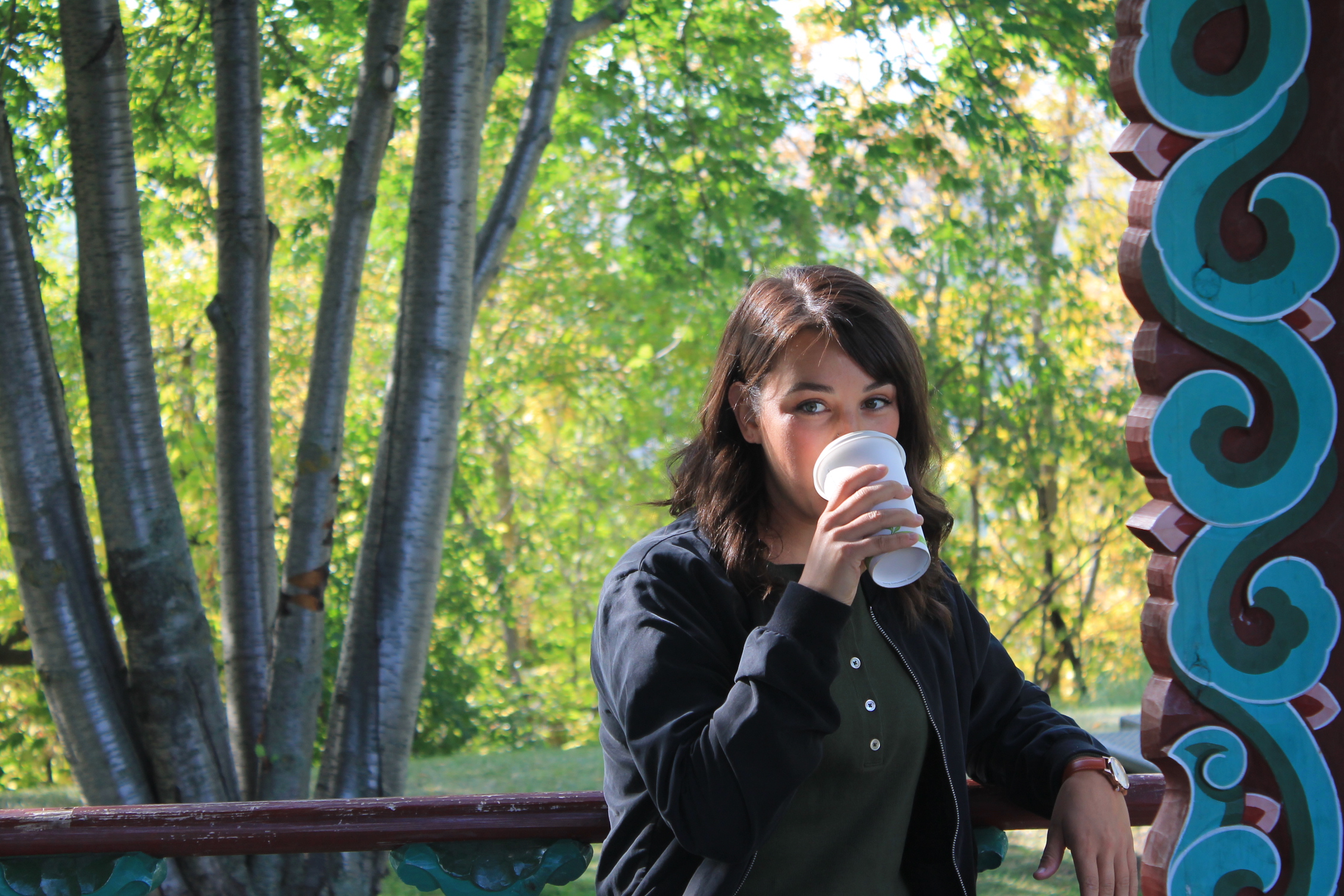
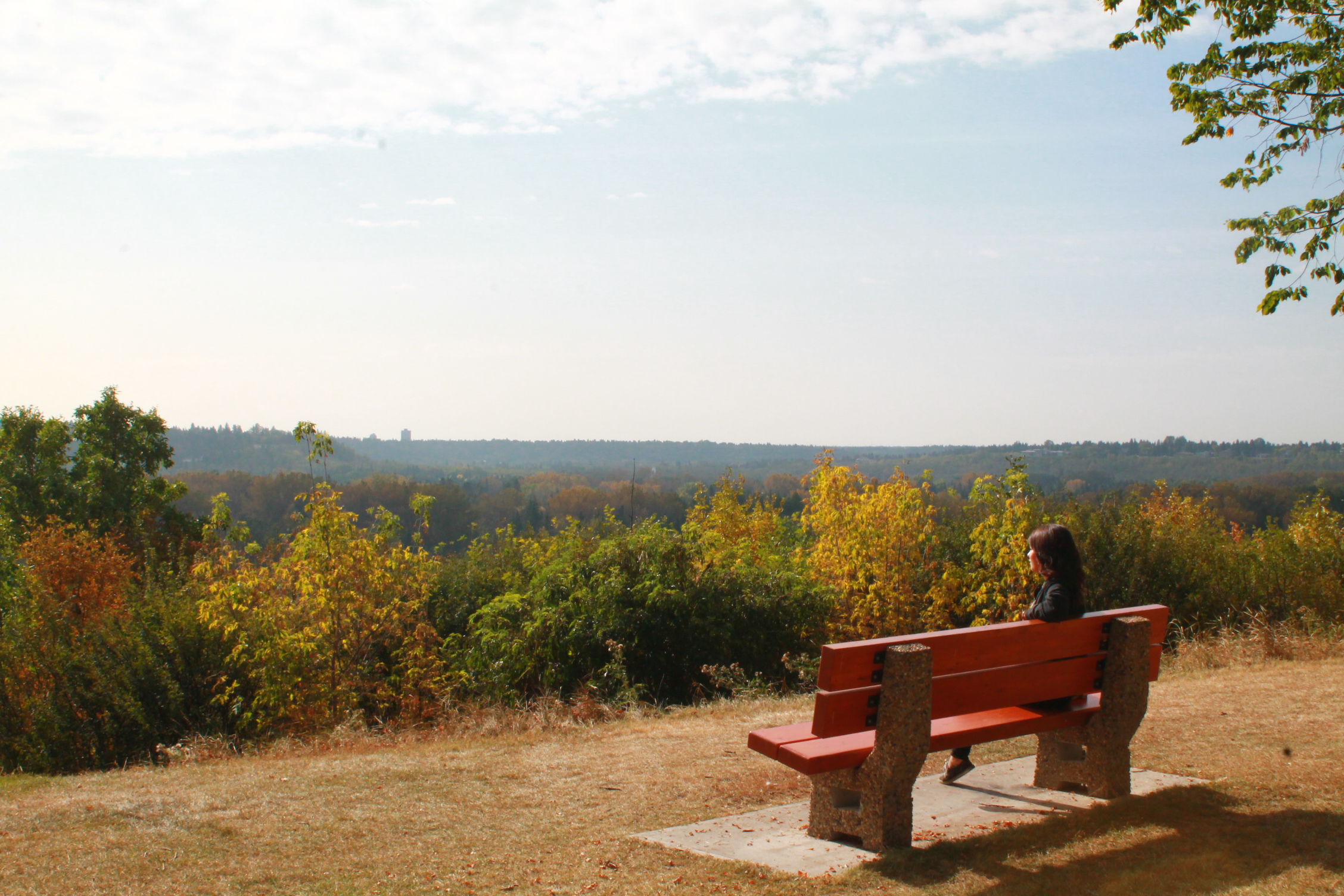
Never one to shy away from offering up her perspective on life’s biggest questions, Erika is bright and eager as she takes the first few sips of her morning’s coffee. Against a backdrop of fall foliage, I am reminded of our own school days: our first friendly interactions as classmates under the brilliance of Dr. Sarah Copland (who kindly introduced us to the ways of Virginia Woolf), and later our continued correspondence as she put her anthropology degree to the test up north in Alaska.
Both of us watch the fog rolling in over the distant North Saskatchewan below, and I am reminded that Erika, like many of my academic peers, has gone away from Canada and come back again; that she’s one of the many of us who are slowly getting used to calling Edmonton home. And like many of my academic peers, too, I know now that she’d also faced the strange reality of going to school while life ‘on the outside’ interrupted again and again. Yet she, like all those others (maybe, like you), seems to bounce back from everything the world’s thrown at her—and has some serious know-how to show for it.
“So, what’s the story then? Where should we start on education?” I ask, the fog of my breath lost in the light of September’s early-morning sun.
“Hm, maybe with…where I went to school? It was my Mom who first got the writing idea in my head after high school. She suggested I go into the Professional Writing Program at MacEwan University – it was a college back then – and…well…you know the rest!” We both laugh for a moment.
“Yes, I do,” I say, “but give me the benefit of the doubt. We have different majors, after all!”
“Sure, sure. Okay so…”
In Search of Education: Pre-COVID Musings on Academic Advancement
Erika starts by telling me how she basically threw herself into a bunch of different disciplines along with professional writing, but that one of her professors there steered her towards the Bachelor of Arts program in English, specifically.
“I mean, of course I wanted to listen to professional!” she laughs, suddenly distracted, eyeing the view behind me.
“Oh my gosh, is that guy proposing?” she whispers, excited. I whip my head around to see a man kneeling on one knee. Both of us crowd behind the pinkish-red pillar of the Jeongja where we stand, staring at the man who (thankfully) does not notice us.
“Oh, No! I was wrong! He’s just stretching. Just stretching, totally stretching,” she says as we both fall into peals of laughter, fully comfortable now in our reunion. It’s been a while.
“Anyway, I’ll be honest. It wasn’t going well at first. I took all of these 100-level courses, any of them I could think of, like computer sciences or astronomy or history, but by doing that I ended up failing a few. I had a really bad GPA the first year and so they put me on—or, well, they just sat me down and said, ‘you’re not doing well and this might not be for you.’” We share a grimace.
“And I was shocked,” she continues, “but you know, stopping wasn’t really an option. Back then I had this mindset where, and I think it had a lot to do with the way I was raised, I just needed that piece of paper. And so, to get back in I had to do this psychology course that actually teaches you how to be a university student. It helps you learn how to schedule and manage your time, and how to study, and it was so beneficial I had to ask myself: why wasn’t this mandatory for everyone?”
Sipping my London fog (hot from Iconoclast just off 124th Street), my mind jumps to a long-held belief I’ve kept since my own time at MacEwan University: that going to class isn’t really about what you’re learning, but how you’re learning it. It’s the writing and studying and managing your time that’s going to translate best into the workforce after graduation. But then, as Erika often does, she switches gears on me so quickly I barely have time to react: [trigger warning, death, illness]
“So, like I said, it was my Mom’s suggestion about the writing program. But then, it was about a year and a half into this whole school thing that she was diagnosed with cancer.”
Another memory comes to the front of my mind: Erika on our last day of classes together, telling me all of this for the first time, almost casually, in passing as class is about to start. She mentions her mother, and her death. I swear I’m listening as present-day Erika tells me how she’d just thrown herself into her studies without looking back, but really I’m stuck in that memory, remembering Erika as I knew her first—how she must have struggled to hold it all together right next to me every day…and how I was none the wiser.
“I just became this adamant student. I didn’t want to deal with family stuff so instead I focused on school stuff, even after my mom passed. I just sort of buckled down. And it was good for me, because I had a good GPA, but then after I came out of school I had this degree that I thought I wanted, only to fluster around trying to find something in my field. Then of course I’d been putting off all this emotional turmoil, so there was even more reason for me to want to focus on: ‘okay, what do I do now’. The obvious answer was education.
I had the idea of maybe going back and getting my Master’s in Anthropology since, I’m not sure if I mentioned, I have a B.A. in Anthropology with only a minor in English. Then while I was working at a few not-for-profits in Edmonton, I started researching volunteer jobs and found a dig here hosted by GM. This would have been…2017, near Mill Creek, and I lived right down the road, so it was kismet: I had found something I could literally ride my bike to. I felt like I had worked so hard, and luckily at my one job I’d banked up all these hours…I was actually able to take a paid month off to volunteer for this dig!”
A Pause for Archaeological Excitements
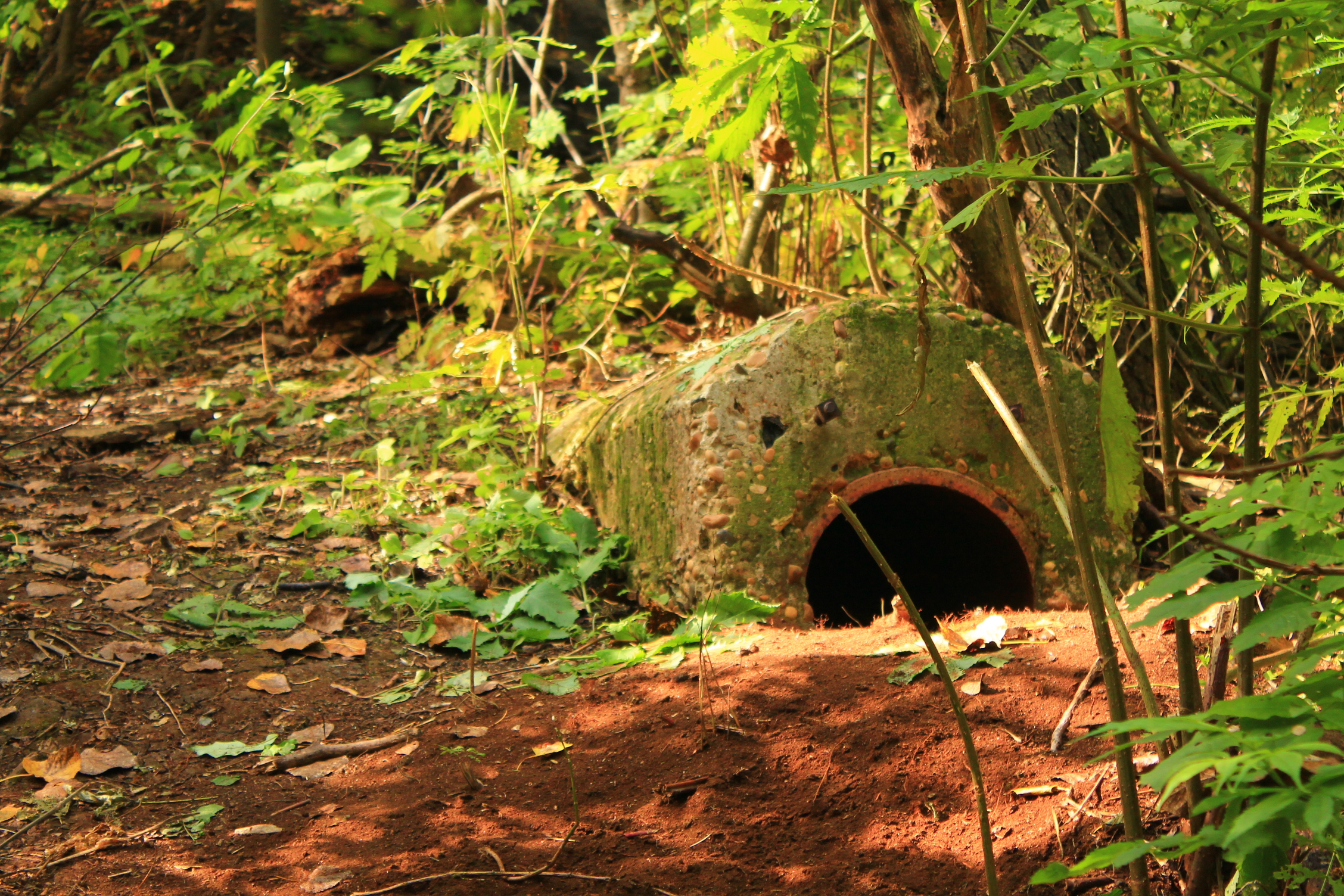
The Drainage Pipe Seen Later
Erika stops for just a moment, and I can’t help but pipe up at my excitement: “Um, excuse me? You did an archaeological dig here in Edmonton? That’s so wild!”
She lifts her eyebrows at my silly surprise—of course there are archaeological sites in and around Edmonton! I giggle nervously and I can see she won’t hold it against me–that we both know this place has heaps of history just waiting to be found. In fact, just after this interview during our subsequent walk along an alien neighbourhood trail, Erika would excitedly point to an exposed drainage pipe, listing off each kinds of system or building to which it could have belonged.
“I did! Honestly it was the thing that really cemented that this was something I wanted to do. We did all the archaeological things: we mapped out little test spots and dug one-metre by one-metre units. We did trowel work sifting and finding artifacts, cataloguing them, cleaning them and then cataloguing them again. It was this whole meticulous process and I loved every second of it because it brought me back to that thing—to being at school where I love learning and working with my hands, and really being able to form an opinion on something.
That’s the most significant part, right? I don’t think you need a post-secondary education to form an educated opinion. You can have a dialogue with someone that has a cemented opinion in something that is founded in some sort of real, substantial thing, and learn just as much.”
I hold onto that thought – the separation of learning from knowledge, perhaps of academia from education. I get the sense that she’ll return to it again later.
“Anyway, long story short, I made it up to Alaska by doing the same thing again: looking around for opportunities that would get me into school. It was almost an obsession, to have a plan. So I made this one where I would go up there and do digs in a state that’s been colonized twice in the last 120 years-”
I stop her again with my naiveté. “By who?!”
“Oh, Jess, there is such a dense history up there! Both Russia and America have colonized that land, and the amount of data up there…! But, for beginners, I have to say that another draw was because – going through our education system – as a white woman I know I don’t have any business talking about anything that’s not mine. So with Mill Creek we were looking for a meat-packing plant from 1907, which didn’t have any documentation due to its size. It was like trying to find a hidden gem.
Actually, we found the footings for it and we found the ground work, so it is there! But its part of a history of Edmonton from the last century or so, and I was really inspired to take part in something with connections to myself. I mean, I grew up in Edmonton and have family that would have been here at that time, and though they may not have worked in the plant, my Uncle for instance lived down the road and remembers it being a part of his life. So I felt like I could say something about it—that I was allowed to speak on it.”
We stop to appreciate the brilliant colours painted on the underside of the Jeongja’s roof before she continues.
“When I went to Alaska, too, I wanted to do industrial archaeology because with the wars and the transfer of land ownership, there is so much still held in place from when Russia owned it and then again from when the States laid their claim. Even though I’m a Canadian…as a Canadian I felt there was probably something there that I could sink my teeth into.”
“And sometimes, as the outside, unbiased perspective, maybe you can say something,” I say quickly before we switch tacts and return to our original subject again.
Gambling with Education: Weighing Risk vs. Reward
“Like I said, my main educational drive for Alaska was to go work there and get my Master’s. I did all this research again, with my plan,and I did end up finding this great program with the Smithsonian exhibit at the museum in Anchorage up there, but in the end life interrupted again and I ended up right back where I started, coming home to Edmonton, not going to University this time, but still thinking that was the only thing that would get me out of this trap, you know? School. And then just like with the dig, which stopped after six weeks, I was only getting my footing and what I wanted, and then it just ended. I started to feel like I was just stopping and starting.”
“Right. Right,” I interject, trying to remain casual with the questions. “I like this train of thought you seem to be hinting at too, with this idea that we go out with this plan of how we are going to get things educationally, how we’ll stop our whole lives and do a bunch of research for this one thing, and as we start going for it, somehow it just doesn’t happen. So now we have this whole educational background that I, for one, am still just starting to realize is even valuable at all…because I didn’t really look at it as learning, those parts where I stopped and started.”
“Exactly, there’s something about the experience of it, the knowledge that I gained just by researching that future, or the ability to be on a path where I can just go for something. And as much as there have been blockades and u-turns, and as much as I wouldn’t want to give up that experience, I’m also only now coming to this point where I realize I’ve gone down this road a lot, and even though I’ve gained a lot from it, it’s not really fulfilling something that I want it to fulfill anymore.
And then, when I do try something, I sometimes feel that I’m not able to grasp onto the same things I felt I was able to when I was in school. To me that’s such a disjarring thing. Already when I came back to Edmonton from Alaska I was ready for that same path: education.” Erika blows the steam off her coffee before taking another sip. “I guess when I came back I just wanted that feeling of..of feeling as if I were doing something day to day.”
A group of middle-aged women set up their camp chairs on the grass nearby and begin their Thursday chatter. Both of us listen in for a moment, enjoying the slight cool breeze on the air. In the distance the city is bright in all its reflective, pastel glass. I watch as one of the women moves her chair away from the others, adjusting the mask on her face.
“Then a global pandemic happens,” I say after a second.
“Then a global pandemic happens,” she agrees, “and once again I’m sitting there cut off. I didn’t even get to plan.”
We’re silent again, though the world around us isn’t. I have this moment where I begin to realize that maybe my education won’t even mean anything anymore, in this new present. It’s a thought that’s been with me often since the whole pandemic started, and each time it rises I try to shovel it down. This time when it rises, I worry I won’t have the strength, but Erika manages to instill a little bit of hope, even as I almost-fall:
“I don’t know. I guess it’s a good thing though. Somehow. I mean…I suppose the most significant and substantial thing you can carry with yourself isn’t what you have gone into education for, it’s how you exist in the world.”
Right. Because everything isn’t always education. Duh, Jessica.
“Actually,” I say finally, after another moment’s notice, “that’s kind of an interesting point. I guess in that sense our answer is to…to not assume the ends when we’re starting. Or, that old cliché: it’s the journey not the destination.”
“Yeah. We can do whatever it is that we think we need to do, but we also need to know at the end of it that it might not get you where you think you want to be going. That’s the risk. But I also think a lot of the time that can feel like failure—as if you haven’t learned anything. It’s a tough journey. I mean, for me I’ll think I’m an idiot or that I’m stupid on the ‘scale’ of educational accomplishment, when really it’s how I’ve gotten myself there, or how I’ve let myself become education-worthy.”
I stop and mull on the concept of being education worthy for a moment, considering its weight before responding.
“Right, so there’s that fight then, where we have to fight with ourselves because we feel like we’ve failed, or we’ve told ourselves that we’ve failed, or someone has told us we have, and we have to fight to turn that around.” I pause, thinking about the day prior, and some failure or another that had sent me off the rails. “For me, that process always looks something like: I get hurt. I take it really personally. I grieve for my so-called ‘failure’, and then I get real spiteful!” I jab my fist in the air and Erika does the same. “Fiesty!” she shouts.
The camp-chair ladies turn their heads and we both collapse into giggles before getting serious again. As she begins to speak, my mind wanders. I can’t help but think of the risks and rewards of education. How in a society that values that little piece of paper, it’s still possible to find a definition of success for those of us who don’t follow that prescribed ‘path’ the whole way through. How you can risk your money, and come out without a job, or risk your time and come out without a degree, but still find value in yourself and your work.
“And yeah, we’ve all heard it before,” she says, “‘you have to fail to succeed’, but I also think that the ability to feel failure as a success—that’s the fight. It’s something you have to train yourself to do. Like a muscle, it may be easier for some, and harder for others, but we can all build it.”
I nod. “Okay! So then that makes me think of the ideas we’ve been posing between…sort of hands-on training and educational learning. Or not those two things, but academic learning and non-academic learning maybe.”
“Totally. And you see how that’s structured into the education system—how you’re just a letter grade. You could be a C-plus, but is that really you? [Can we get this as a tagline, someone? A sub-heading?]. And I think another conversation that’s being had more often is that it’s not the issues within the system, it’s the system itself. Sometimes I even think that the education we had can no longer exist now.”
“You could be a C-plus, but is that really you?”: Value and Worth in a ‘Post’-Covid World
“I’m pretty here for every kind of breakdown,” I respond. The sudden talk of revolution gets the attention of the magpies who laugh at us from atop the Totem pole (Haida: gyáaʼaang) overlooking us from the southeast.
“If it means putting a stop to that need for that piece of paper, or certificate, or that habit where we keep negating everything we’ve done and learned along the way…” she stops, looking to the magpies who have again gotten our attention. “Gone are the days where you list your credentials,” she says finally, not looking at me.
“Do you think that’s true because of COVID, or just because?” I ask. She thinks on it a second, her eyes unfocused. I can’t tell if our train of thought gets lost in the distraction, but when we resume, it seems the conversation has shifted again, if only slightly.
“Before…I was getting the feeling of being so lucky that we lived in a world where if you didn’t want to work somewhere anymore, you could really make a plan to move into a new career through education. It seemed totally doable.”
“Even to feel like we could,” I say. “To tell people that that was something we wanted. I mean, in the past I told my fair share of bosses the reason I wanted to leave was to grow elsewhere, and they’ve always been receptive to that.” I stop speaking, but in my head I begin thinking of the too-many conversations I’ve had within my network of colleagues and friends recently—how they’re afraid or simply can’t leave their jobs right now, regardless of how bad things are. We live in a new reality. The questions are different. I decide to alter my tactics.
“Okay, maybe off the cuff with this then, but another loaded question, you know me. And I do find myself thinking about this a lot lately, so…bear with me but: do you think it’s worth it to go back to school right now?”
She doesn’t even skip a beat in answering:
“No. Oh no. If you’re paying the same tuition fees that you would be by sitting in a classroom and actually having that learning experience? No. And honestly I’m beginning to think there’s going to be things like…you know how on certain medical exams when you’re travelling, where you’ll fill out an exam that asks were you in such and such country at this time? And if you were, then they have a medical test for you? Well there’s going to be tests like that in the career world where they’ll be like, did you get your degree during COVID times? Okay, well we have extra work for you to do because we don’t believe the academics you received were substantial of the job you’re applying for.”
Erika stops to fiddle with the lid of her now-empty coffee cup. “I think being a student right now, there are going to be ebbs and flows, but you’re not going to be getting the same education that you would be getting outside of COVID, so you’re not really applying for the same jobs in the same structure.”
“Right, and the curriculum itself was bred and grown out of a non-COVID environment, and now it’s like, how can we measure those skills? How do they bridge over? So, say, you want to study archaeology but you can never go near anyone? The protocols are all completely different now!” I’m a little hysterical, but between us, the energy is business as usual. (I also have the inkling that our caffeine is kicking in).
“As much as that sounds terrifying though, I can’t help but love the idea that this is a kind of forced shift,” she says.
“Right, because it was already happening, and now we have to adapt or die. At least, I know that leaders have been thinking the onus should be on employers to train and educate as opposed to institutions for a while, instead of just trying to allow their degree to speak for them. There are already jobs – and they’re probably succeeding right now – who have these great training programs, who are willing to invest in professional development.”
“Mhmm. But not all. There are a lot of jobs and employers who are trying to figure out how to function right now, and I think the bigger dilemma here is how do you hire after COVID? What is my credential as a business owner even worth in an economy that’s already moved on, especially with these people suddenly being in a position to say, ‘well, I’m sorry, but you were educated during these and these years and that’s just not good enough’.” She pauses a second before continuing, stretching her arms, her shoulders, her back.
“And I mean, we as adults and employers for those kids…we are going to have to step up and build a foundation for them to go to afterwards. There was already a disparity in access to education and technology, and its true now more than ever. More people are going into public spaces or requesting the use of laptops or computers or iPads—anything to access their assignments. And that’s just to go to school, let alone get a job. Plus you’ll see a bigger gap in wage…
…but once you get beyond those structures and barriers and all the issues there, when you get to actual learning, that piece of paper…more people are going to have to ask what that really means. I don’t think it’s going to have the same weight anymore, and honestly, I think that’s a great thing.
Because as it is now, and kind of as it was, you are going to be able to have an education, but still have a crummy version of life, because the world you go out into with that education is not receptive to you, especially if you’re an introvert, or disabled, or poor, or a person of colour, or a woman…you have these hurdles already stepping into the ‘cult of education’, and still find that in the end it means nothing.”
“Hmm. Yes. That’s a tough pill to swallow,” I say. My last sip of tea gone, our conversation seems to be heading for the close. Knowing we will have our own wayward chats following this small interview, I don’t mind rounding things out with a final touchpoint:
“I do like the idea that education and learning and knowledge aren’t just some mechanism you can feed into and get a specific outcome. Right now it feels like we’re moving farther and farther away from that.”
“Right. And I don’t think we can have a solid image of what people who are going through education right now might be experiencing, but I do think that we all have more of an option now to say no to standard education.
And if someone is going through their education right now, then they should talk to and reach out to family and their community, and should make their voice heard so their screen-education works for them. They need to show up at online discussions and take hold of what their education can be. It’s okay to step away from that structure that is set up for us…you know, where we sign up and they administer and then we leave. And I think now more than ever we have the ability to create what that education paradigm is. Whatever your feelings toward it—if you’re upset or scared or excited—utilize it.”
“Nice. So, we need to help ourselves and help others widen the concept of what education really is—and how to measure knowledge…that sum it up?”
“I’d say…that’s about it!” she’s grinning ear to ear as I click the big red record button on my phone for the second time in an hour, summing up the parts of our conversation that would be remembered long after the meeting ends. And as we go off on another adventure, talking openly about our lives and kicking up newly fallen leaves, I can’t help but wonder what kinds of measures we will use in this near future to ‘grade’ education, learning, and knowledge, and the extent to which our openness to this change will be the backbone to our survival.
And we’d learned a few things about that old house, the tall thin one with too many stories it seemed. Like how we all felt safer in one room with all the doors closed, or that it was better to light three candles than one. Or that if me and Lita – but only us – sat in the two chairs by the indoor tree on the third floor with everyone around, noises would begin and we would all giggle and jump up and clap, happy that we’d scared everyone once again before we all fell to bed, at least one of us up still and watching the ceiling for spiders or rats or whatever anyone else was dreaming of that might come to life there. For everything felt possible, in the swirls of the wood grain, as the distorted faces of creatures leapt from one wall to another.
But this was our childhood, and such things happen all the time in other towns, in other books, when a small chilly wind scares everyone out into the street. But not us, no, never us, because we’d read all those stories, seen all those ghosts, been to every grave we could find.
And so, we decided in our foolish bravery to push things a little further and bring our smaller siblings; to scare them and show them we were daring and strong, that only we could save them from the worst. But of course, our parents wouldn’t let them come alone, and even some of those came along to see what we were up to; wanted to see inside for themselves, all of them having known the house since they were young, along with all the stories and all the ghosts. Some had even held their own conferences in those very rooms, where footprints were dusty and old clocks still ticked and nothing was ever light, even in the morning.
That’s why we brought them, about twenty in all, crammed into our favourite room on the third floor with the chairs in the corner and the tree – a living beam of one wall – next to a stained-glass window covered in grease. In unison, we sat and ate our bread, and laughed and tried our hardest to disturb the spirits and make them angry; to make them so angry they’d come alive and give everyone a small story of their own to talk about over and over again, tucked safely away under their covers at home.
So, to keep spirits up, to feed the fear that seemed to be rising from the little ones, and to make the adults as scared as we had once been, we told everyone to sit in the chairs in pairs, to feel their evil as we had already, Lita and I, who seemed to cause the house the most anger, perhaps because we were so young and still pink, or maybe because the portrait upstairs had our eyes, as if our own ancient families had been there once too, and had left their marks in oil for us to see.
And when Lita and I finally sat, together after all the others had their turn, the house began, as it always did, to softly rattle and shake, as if a wind had been let loose in the rafters, buffeting every wall with its wails, stopping only at our door and screeching for entry into the room where everyone held three candles each. But Lita and I knew. We knew nothing worse would come of it, knew that nothing else would happen.
So we laughed at the house because it could not hurt us. We laughed, and for the first time, we held hands, maybe to scare all the silent ones even more, my palm flat and up, hers the same and down, our fingers matched in length as they hovered above our knees, all four trembling as Lita and I began to tremble in our seats, not for fear, but because the wind had gotten in and was pushing against us, against the chairs, our candle flames, the tree. And amidst the swirling Lita kept saying things in a voice I wasn’t sure was hers anymore: saying that she could read minds, our minds, and knew how to make the tree breathe again.
Hands still together, now clasped, fingers entwined, nails digging deep and drawing blood, I was not myself but watching from another’s eye, us two, as we sat vibrating in the seats we thought would never hurt us, our faces contorted in the dark as Lita began to shriek and all the candles went out.
All was still in the darkness then except for the tree, glowing there in the corner like an unwatched television screen, there in the dark of a sitting room that had never seen the likes of one. We watched as the static frilled from branch to branch, back and forth, blue and eerie, forming nothing truly, but everything with the help of our frantic imaginations, all of us seeing the worst, and the worst still as Lita quieted her screaming and started mumbling, describing a woman only two of us knew.
“Her black hair is upset, her white face twisted in anger, at us, at us, at us.”
And out of my own mouth, not my voice, but a groan, like words unfolding but stoppered in my throat, like a ball of saliva too thick for the tongue to remove. And grasping, gasping, trying to clear a passage for the words to escape, I lose sight of them all, listening to the words finally broken free, not from my mouth but from all of me, as if my entire body were saying:
“You see yourselves now, but I would see you sooner gone, gone, gone.”
None of us, not even me, could help but look. We looked at the tree whose static formed her horrible face, a twisted grandmotherly face which still seemed so like Lita’s and mine. And then, the face was ours, one after the other, in grotesque succession, our tongues lolling to the sides, until it was just Lita and I left alone glowing in the silence. In the dark.
All around us is silent, though I can barely see now the candles splayed along the floor with no one left to hold them.
Had we been spared because we called her? Had we given her our families to choke?
No longer did the ropes that seemed to bind us rub against our throats; Lita and I fled, not out, but up, to the room where she called us, with the canopy bed and all the red curtains blocking the windows, where we’d first seen her face in that painting. But beautiful as it was then, all the more it is now, with my eyes and Lita’s lips, the fruitful blood of our siblings, of our parents, dripping from the wooden frame over our bared soles.
But we knew again: we had been saved, and in that, elation rises, grows so fast that neither of us could look away from the woman as we linked arms and danced thankfully under her portrait, her children finally, floating, lighter than before—or at least Lita was, as she smiled at me from above and drew all the curtains, raining down to the floor as one, revealing all those we’d thought we’d lost on the opposite bank, level with us, smiling like it was some big joke they’d played on us instead, and waving too, those sisters and brothers, telling me it was time to go home.
As I try to go to them from the window, to meet them again and laugh about this scary night, their smiles fall, and they all, one by one, turn away…
“We cannot go,” says Lita, “we are not free. My arm is tethered, we cannot leave.”
My wrist is tied, tied to hers tightly, captive as I look back – how could I not have noticed – that Lita bleeds and spins from the ceiling, grinning like the woman in the painting whose winning grin is true, as I scream and scream and scream at the sight of Lita hanging from the ceiling, neck tight in a noose.